|
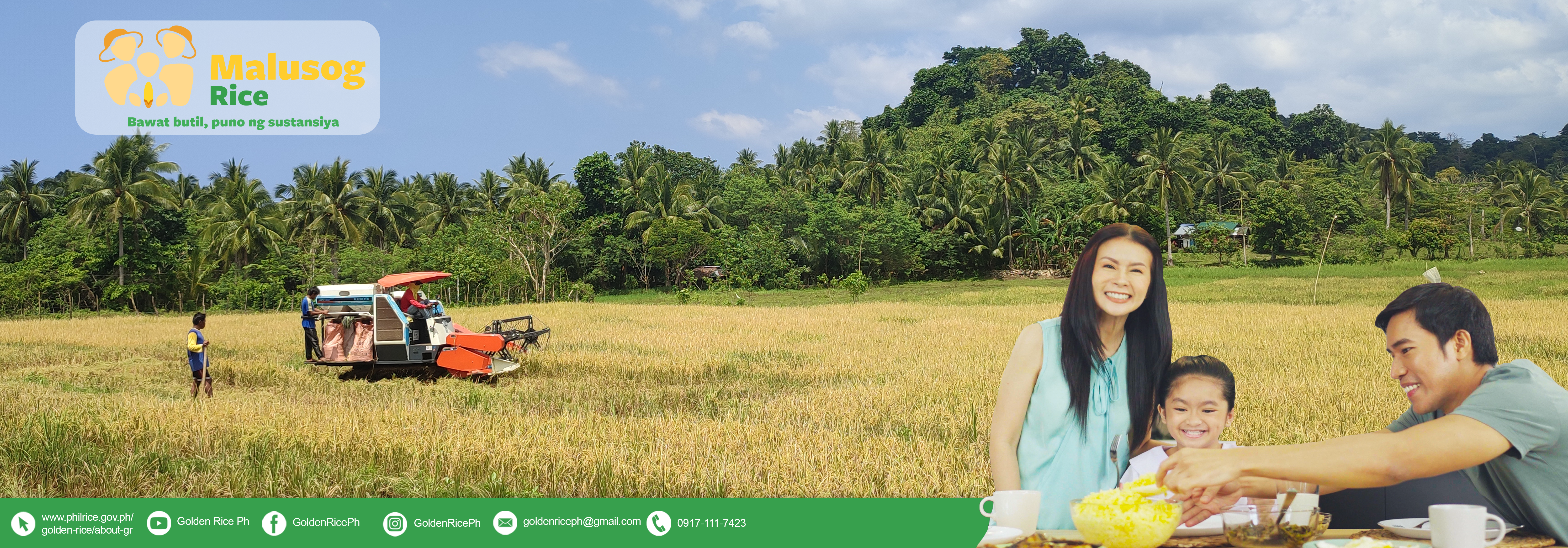
What is golden rice?Golden rice (GR) refers to genetically modified (GM) rice developed to produce a carotenoid called beta-carotene. This beta-carotene becomes vitamin A when processed by the body and gives the rice grain the yellow-orange or gold color, hence the name “golden” rice. How important is vitamin A to the body?Vitamin A is an essential nutrient needed to keep the body, specifically the eyes, healthy. Lack of vitamin A, also called vitamin A deficiency (VAD), damages the immune system, therefore, increasing risk to common bacterial and viral infections and rate of mortality especially among children. The weak immune system is usually followed by poor eyesight that can lead to night blindness, which may also result in permanent partial or total blindness if the depletion continues. How serious is VAD in the Philippines?Around 4 of 10 children aged 6 months to 5 years and 3 of 10 school children have VAD. Likewise, around 1 of 5 pregnant and 1 of 5 lactating Filipino women have VAD.
VAD is a common micronutrient deficiency mostly affecting children and pregnant women in developing countries. It remains to be a problem despite interventions such as vitamin A fortification and supplementation because these do not reach all the target people and require large volume of supplements, efficient supervision, monitoring, and follow-ups. So why rice?Many food can be a source of beta-carotene or vitamin A. Beta-carotene can be obtained from plants with pigments such as tomatoes, carrots, squash, and green leafy vegetables.
Animal food products, on the other hand, can readily provide humans with vitamin A. This is because animals, just like humans, can synthesize vitamin A from the beta-carotene in the plants they eat. Some people, however, cannot afford to buy meat and other animal-based food products very often and they do not have access to a variety of food.
Hence, a rice variety with beta-carotene offers a sustainable solution to VAD since rice is eaten and grown in more than 100 countries, including the Philippines, and is the basic staple crop for 2.6 billion people. Rice provides 50-80% of total caloric intake in most Asians, who are most affected with VAD. Rice can reach even remote areas as compared to vitamin A supplementation.
Likewise, Asian farmers can benefit from such a solution because it will not pose additional costs or labor while consumers will not need to modify their eating habits and traditions just to meet their vitamin A need. Therefore, golden rice is expected to be an effective, sustainable, and low-cost tool — in addition to existing strategies — in helping overcome VAD among the people who depend mostly on rice for nourishment.  Is golden rice safe to eat?Like all GM crops, golden rice undergo safety evaluation as it is developed. Therefore, golden rice, when released, will be safe to people and the environment. The National Committee on Biosafety of the Philippines (NCBP) under the Depratment of Science and Technology (DOST) is providing regulatory oversight to GM research under contained condition, while the Bureau of Plant Industry (BPI) is strictly monitoring field trials. Hence, once a golden rice variety becomes available, it is certain that this has passed the stringent safety tests of the afore-mentioned institutions. How much golden rice should you eat to prevent VAD?In rice-based societies like the Philippines, available data under certain assumptions show that eating 3 cups of cooked Golden Rice 1 can meet the recommended daily vitamin A intake of a person. However, further studies are still being conducted to answer this question. What will happen if a person overeats golden rice?There is overdose in vitamin A but not in beta-carotene. Golden rice has beta-carotene, not vitamin A so there will be no problem if a person eats a lot of golden rice.
There is no evidence that conversion of beta-carotene to vitamin A contributes to vitamin A-related complications even when beta-carotene is ingested in large amounts. This is because the body will not convert beta-carotene into vitamin A unless the body needs it. Hence, it has been considered virtually safe because humans tolerate high amounts of beta-carotene without apparent harm (Hathcock, 2004). Will golden rice be more expensive than regular rice?No. The technology involved in developing golden rice is free because its inventors, and even Syngenta, which has been given the exclusive rights to the golden rice technology by its inventors, has released all intellectual property rights to the public sector through the Golden Rice Humanitarian Board.
As a result, the Golden Rice Humanitarian Board has the right to sublicense golden rice to public breeding institutions for free. Likewise, successful varieties developed by the private sector will be donated for public use (Paine et al., 2005).
Since no company has plans to commercialize a golden rice product in developed countries or developing countries, its price is expected to be comparable with its regular polished counterpart and with other varieties. Who developed golden rice?The first golden rice was developed by Dr. Ingo Potrykus and Dr. Peter Beyer in 2000. But upon realizing that they need additional skills and expertise to further improve their invention and to deliver it to countries where VAD is prevalent, they teamed up with Syngenta, which produced golden rice with even higher level of beta-carotene. Syngenta eventually donated these materials to the Golden Rice Humanitarian Board, which oversees the development of golden rice in several rice-growing countries including the Philippines. How is golden rice developed?Golden rice technology is based on a simple principle. Rice plants accumulate beta-carotene in their leaves but not in the grain. By addition of two genes (Phytoene synthase and Phytoene desaturase) using modern biotechnology, the beta-carotene is consequently accumulated in the endosperm, the edible part of the grain. Is PhilRice developing golden rice?
Yes. Two popular rice varieties are currently being developed by PhilRice to have golden rice counterparts, and consequently fight VAD. These are PSB Rc82 (Peñaranda) and NSIC Rc128 (Mabango1). The International Rice Research Institute (IRRI), on the other hand, is developing a golden rice counterpart of IR64 and other Asian rice “mega varieties.”

Breeders are using various methods to help ensure that these will have comparable yields, pest resistance, and eating quality with that of the original varieties.
|